
For years, technological advancements have continued to change the way we live and work without necessarily causing widespread anxiety about human relevance. We were not particularly concerned when chalkboards evolved into interactive boards, bulky computers became laptops, or travelling by canoe gradually gave way to air travel. However, the rapid advancement of Artificial Intelligence (AI) seems to have introduced a different kind of concern: the fear that technology will eventually take over human jobs.
Within the technology industry, graphic designers are increasingly competing with AI-generated designs, while individuals with little or no coding experience can now use AI tools to generate code and build basic applications. This raises an important question: as AI continues to advance, who will remain relevant? Will it be the technology itself, the professionals who understand how to develop, programme and train it, or the everyday users who may become increasingly dependent on its capabilities?
FROM TOOL TO TEAMMATE: HOW AI IS CHANGING WORK
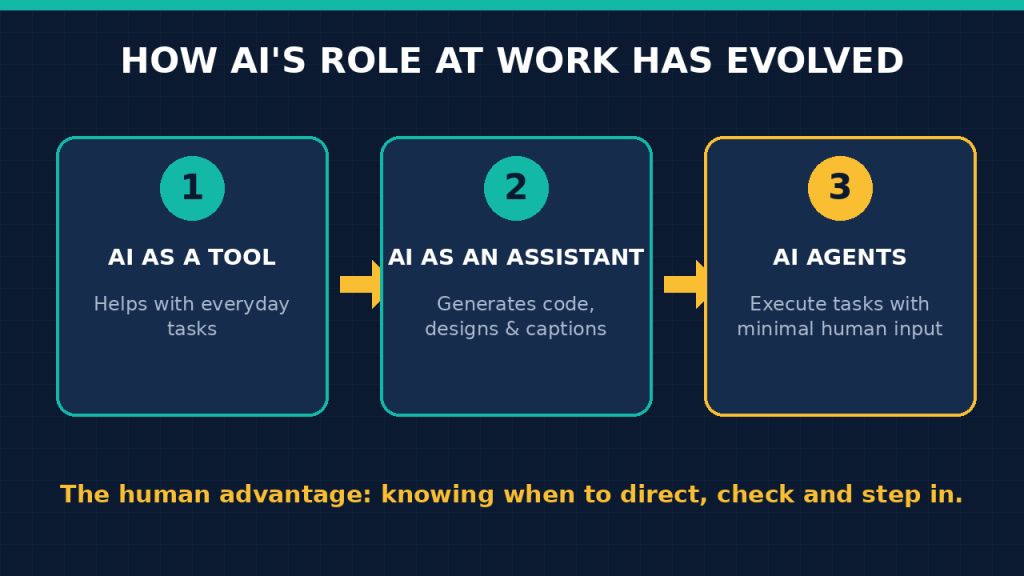
Initially, AI was embraced as a tool that would make work easier by assisting individuals with everyday tasks. However, its capabilities have evolved beyond providing assistance. With the emergence of AI agents and autonomous AI systems, technology can now execute tasks, make recommendations and complete certain processes with minimal human intervention.
Across different industries, professionals are increasingly incorporating AI into their daily responsibilities. Graphic designers, for instance, can use it to remove image backgrounds, generate visual elements and create basic layouts. Software developers can rely on it to generate code, identify errors and build basic application structures. Digital marketers, data analysts and other technology professionals are also discovering ways to integrate AI into their workflows. Consequently, what was once primarily a tool for improving productivity is becoming increasingly capable of performing some of the actual work.
This development has raised important questions about the future of employment and the relevance of acquiring technology skills. Although AI can automate tasks that previously required human effort, its growing capabilities do not necessarily mean that entire professions will disappear. Instead, the nature of work is changing, with some roles experiencing reduced demand while others evolve to incorporate new technologies.
This shift is particularly significant in the technology industry, where skills such as software development, graphic design, data analysis, cybersecurity, digital marketing and IT support are increasingly influenced by AI-powered tools. While repetitive activities involving basic content creation, data processing and routine coding may become easier to automate, responsibilities requiring critical thinking, creativity, strategic planning and complex problem-solving still depend heavily on human expertise.
As a result, acquiring a technology skill remains valuable, but simply knowing how to perform basic tasks may no longer be sufficient to remain competitive. Aspiring technology professionals must develop a deeper understanding of their chosen fields while learning how to integrate AI into their work. Continuous learning and adaptability therefore become essential as the tools, processes and expectations within the technology industry continue to evolve.
Ultimately, AI presents both a challenge and an opportunity to improve productivity, create new career paths and redefine existing professions. The advantage will belong to individuals who can combine technical knowledge with human creativity, sound judgement and the ability to adapt to an increasingly AI-driven world.
WHAT DOES THE FUTURE OF EMPLOYMENT LOOK LIKE?
The changing nature of work is already reflected in projections on the global employment landscape. A report by the World Economic Forum projects that 85 million jobs will be displaced by 2025, while 97 million new roles will emerge, resulting in a net increase of 12 million jobs globally. It further estimates that 92% of IT jobs will be transformed by AI, with entry-level positions (37%) and mid-level positions (40%) particularly affected.
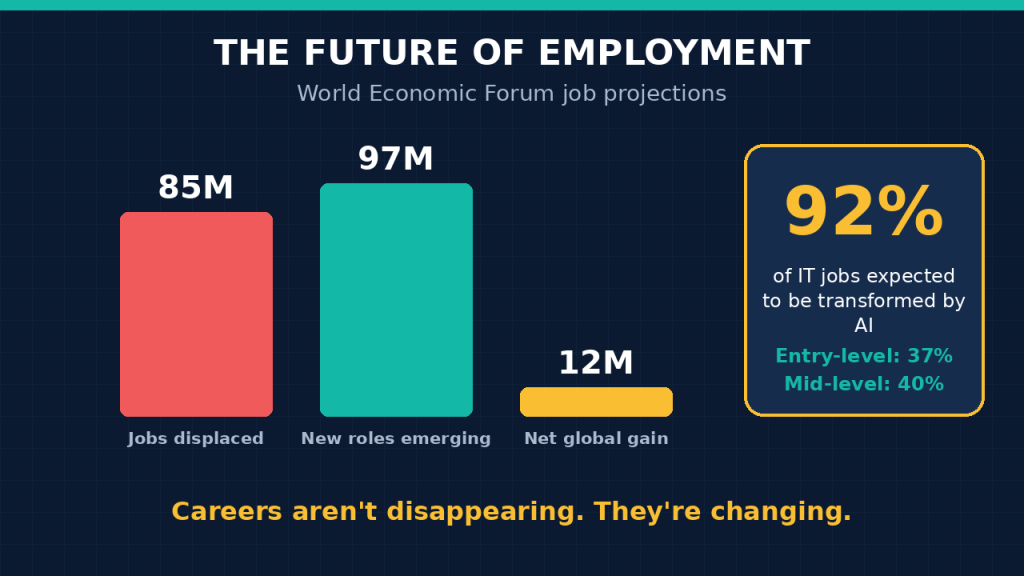
These projections suggest that although AI may take over certain technical responsibilities, technology careers are not necessarily disappearing; rather, the skills and responsibilities required within these professions are changing. This highlights the importance of establishing foundational technology knowledge before progressing into more advanced areas of the industry.
Thus, there is the need for continuous learning, improving existing skills and developing the ability to work with AI, alongside strengthening creativity, critical thinking and problem-solving abilities. This reinforces the importance of acquiring basic technology skills, as individuals need to understand the tools they use, adapt to technological changes and position themselves to take advantage of emerging opportunities.
HOW AI IS CHANGING DIFFERENT TECHNOLOGY PROFESSIONS
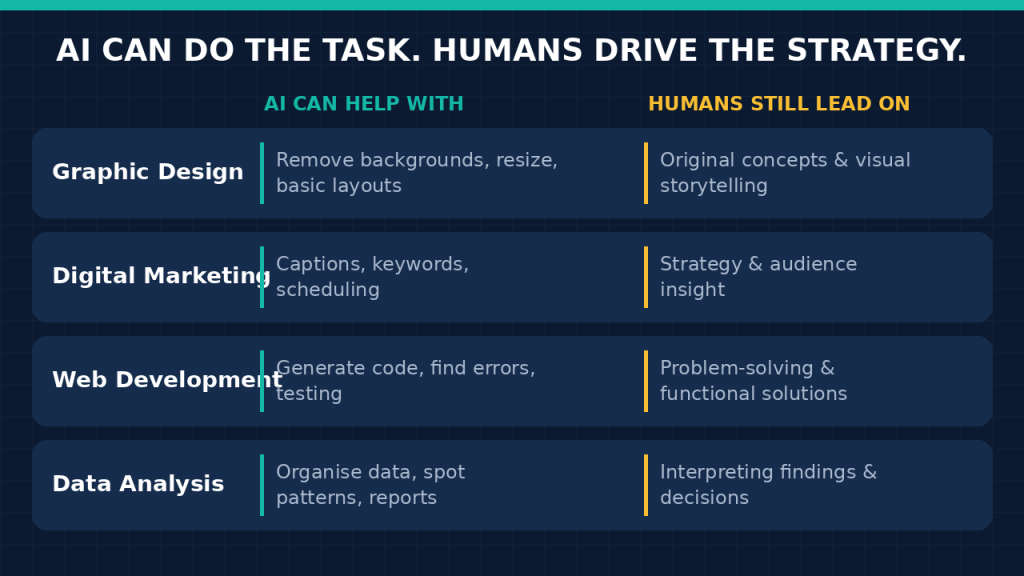
One of the most noticeable ways AI is influencing the technology industry is through its ability to automate repetitive and routine tasks. In graphic design, for instance, AI can remove image backgrounds, resize designs and generate basic layouts, but creativity, visual storytelling and the development of original design concepts still require human input. The same applies to digital marketing, where AI can generate captions, research keywords and schedule posts, but developing effective marketing strategies and understanding audience behaviour require human insight.
In web development, AI can generate code, identify errors and assist with software testing, yet problem-solving and building functional solutions require technical understanding. Similarly, in data analysis, AI can organise information, identify patterns and generate reports, but interpreting findings and making informed decisions still require human judgement.
These developments should not discourage individuals from pursuing careers in technology or acquiring relevant skills. Instead, they highlight the importance of understanding how these technologies work and learning how to use them effectively. The objective should not simply be to compete with AI, but to develop the technical knowledge and professional expertise required to work alongside it.
Understanding the processes behind a particular skill also enables individuals to direct AI tools, assess their outputs and identify when human intervention is necessary. In this regard, learning a technology skill goes beyond mastering the execution of tasks; it involves developing the knowledge to understand, improve and apply technology to solve real-world problems.
WHY HUMAN SKILLS STILL MATTER IN AN AI-DRIVEN WORKPLACE
Beyond technical knowledge, the ability to demonstrate distinctly human capabilities remains equally important in an increasingly automated workplace. Although AI can process information, automate tasks and generate outputs, professional success often depends on how individuals apply their knowledge, judgement and creativity. Emotional intelligence, for instance, enables professionals to understand people’s needs, build trust and navigate workplace relationships. Similarly, active listening and effective communication allow individuals to understand context, interpret concerns and respond appropriately, particularly in roles involving customer relations and teamwork.
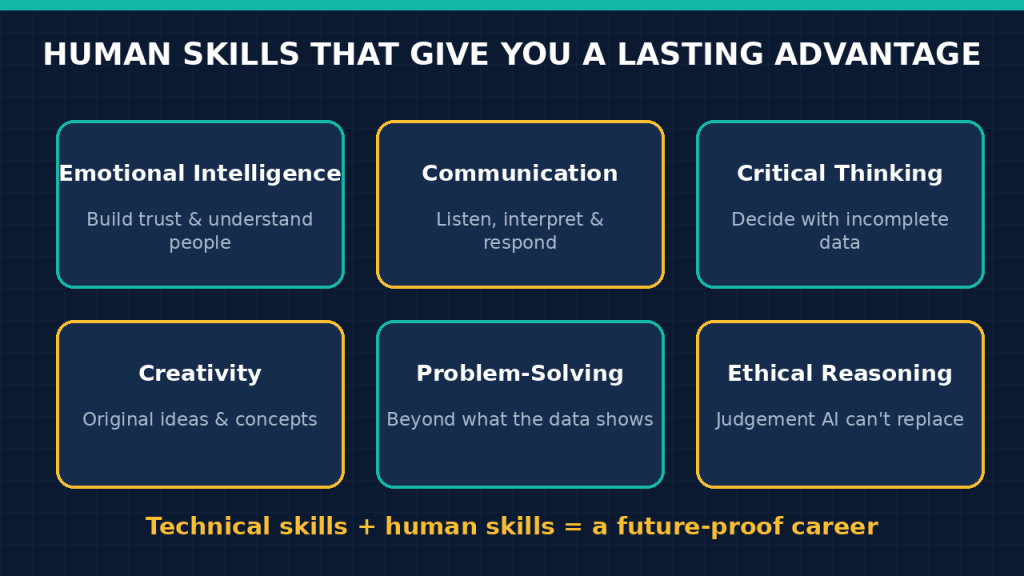
Another important consideration is the role of critical thinking in evaluating information and making decisions, especially when situations involve incomplete data or uncertain outcomes. In graphic design, AI may generate layouts and edit images, but a designer’s ability to challenge conventional ideas, understand a brand’s identity and develop original concepts remains valuable. Digital marketers, likewise, must go beyond generating captions to understand audience behaviour and develop strategies that achieve business objectives.
These capabilities extend to problem-solving, ethical reasoning and making decisions that require an understanding of circumstances beyond available data. Therefore, the future of work will not depend solely on how well individuals use technology, but also on how effectively they combine technical expertise with human skills. Learning to use AI is important, but developing the human abilities that guide how it is used is what gives professionals a lasting advantage.
CONCLUSION
As artificial intelligence continues to advance, the knowledge and capabilities required to remain relevant in the workplace will also continue to change. Rather than viewing AI solely as a threat to employment, individuals should recognise the importance of adapting to the opportunities and challenges it presents. Acquiring technology skills, understanding AI applications and strengthening human capabilities such as creativity, critical thinking and problem-solving will become increasingly important.
More importantly, learning should go beyond understanding how to perform a particular task to developing a deeper understanding of the skill itself. While AI may automate certain processes, the ability to think, create, make sound decisions and apply technology to solve problems remains valuable. The future will favour individuals who are willing to learn, adapt and evolve alongside technological advancements.
Ultimately, the question is not simply whether AI will replace human jobs, but whether individuals are prepared to evolve with the technology shaping the future of work.
Interested in developing these skills? New Horizons Nigeria offers technology training to help you begin your journey into the world of software development and beyond. Take the first step towards turning your ideas into reality. Learn a tech skill at New Horizons today.